

Impact Communication — Case Study
From Claims
to Proof
How a circular vintage eyewear brand stopped saying "we recycle our frames”, and started proving it, frame by frame.
576
Frames rescued restored and returned to circulation — 2025
92%
Repurposed vintage or previously loved pieces
3
Deliverables built to make the numbers speak
The problem
They were doing real work. No one could tell.
A New York–based vintage eyewear brand had built something genuinely rare: a circular business model that rescued designer frames from second-hand markets, dead-stock archives, and forgotten collections, and gave them a second, sometimes third, life through artisanal repair and restoration.
But their communication didn't reflect it. They were making sustainability claims without the data to support them. Phrases like "we love sustainability" were doing the heavy lifting for a story that deserved specificity, evidence, and depth. In an era of rising greenwashing scrutiny, good intentions without proof aren't just ineffective, they're a liability. The brand needed a system. Not a rebrand or better copywriting. A foundational layer of data, measurement, and language that could make their existing work legible — and defensible.
"The story wasn't missing. It was hiding inside every frame they repaired.
The work was to surface it, and build the infrastructure to keep telling it."
The insight
Every frame has a journey. The journey is the strategy.
The lifecycle of a rescued frame: from a designer store to a consumer, to abandonment, to recovery, through an optician's hands, to a second sale, is not just an operational fact. It's a narrative unit. Each origin, each intervention, each destination carries human meaning that can be measured, communicated, and felt. The insight was simple: stop inventing a sustainability story and start documenting the one already happening, piece by piece, repair by repair. Then build the system to translate that documentation into communication their audience could actually connect with.
The framework
Evidence-to-Narrative Framework
Variable 1
Origin Source
Where a frame came from: second-hand market, dead-stock, vintage archive, supplier new, determines the baseline environmental context of each piece and the starting point of its story.
Variable 2
Intervention Depth
Minor (screws, pads, hinges)
Structural (lenses, rims, temples)
Full Restoration (a combination of both)
The depth of repair determines how far the frame traveled to continue its path.
Variable 3
Country of Origin
Sourcing geography shapes the supply chain footprint. A frame from Germany requiring minor alignment tells a different environmental story than one from Egypt requiring full restoration.
Impact Matrix
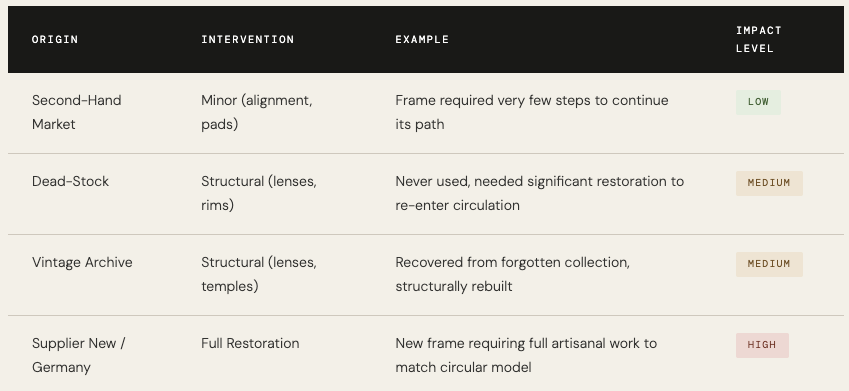
How origin and intervention combine into impact
What was built
Three systems. One coherent voice.
01
Impact Tracking Database
A structured system to log each repaired or
repurposed frame, capturing origin
source, intervention type, country, and
impact category. Built to scale with the
business and generate monthly and yearly
reporting data.
02
Editorial Impact Report
A designed, publication-format document
translating the database output into a
human story, framing waste diverted,
frames rescued, and circular impact in
language that is specific, honest, and
emotionally resonant.
03
Claims & Messaging Framework
A workshop-based system to align the
team's language around what they could
actually claim, replacing vague
sustainability language with data-backed,
story-led communication their audience
could trust and verify.
+
Social Content Translation
Database outputs translated into social ready
visual communication, making
impact data accessible and shareable for
consumer audiences without losing the
rigor behind the numbers.
The shift
From sustainability as sentiment to impact as a documented practice.
The brand moved from broad sustainability language to a repeatable communication system grounded in its own operations. Each restored frame became both a data point and a narrative unit, allowing claims, reporting and social content to emerge from the same evidence base.
The shift was not simply better language. It was a new relationship between operations and communication, one in which the story could grow directly from the work, frame by frame.